
Large and small businesses alike have delivered low-key performances.
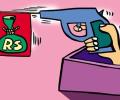
Total net debt-equity ratio improves for third consecutive year, while investment in new projects hits a 10-year low, says Krishna Kant.

Ties between India and the United States have been strained in recent years because of trade policies and patent disputes.


Indian companies are likely to shell out an average salary increment of 10.3 per cent in the current fiscal with employees in pharma, health care and life sciences projected to get 12.4 per cent raise, says a survey.

Happy at the clear mandate given by voters to the BJP-led NDA, India Inc on Friday exuded confidence that Narendra Modi will initiate bold and decisive policy reforms to promote economic growth.
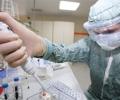
Import alert on Ranbaxy's Mohali unit; Strides' injectible arm gets warning letter

Though the intent has been hailed as good for the economy, teething problems remain with a five-rate structure for various goods and services

Few top honchos of India Inc did very well in 2014.

Project, infrastructure sector emerged as the top employment generator in March with 12 per cent rise in demand while petrochemicals industry reported 9 per cent growth.

Top companies in China are valued at 7.7 times the trailing 12-month earnings against a P/E ratio of 18.6 times for Nifty 50 companies.

BS Annual Awards 2014: Power-packed jury picks the best 7 of corporate India

The biggest spender was Tata Motors, with Rs 4,224.6 crore assigned under the R&D head.

FDI in drugs and pharmaceuticals was $487 million during April-August 2012, according to the latest data of the Department of Industrial Policy and Promotion.

Hit by the new drug pricing policy and regulatory interventions, growth rate of the Rs 72,069-crore Indian pharmaceutical market has slowed down to 9.8 per cent in 2013 as compared to 16.6 per cent in 2012, says a report.

The recall is the latest in a series of problems to hit Ranbaxy, which has had all its India factories stopped from sending drugs and ingredients to the United States.

Like pharmaceutical companies globally - which used to enjoy a preferential exchange rate in Venezuela - Indian producers have been left badly stung by the collapse of the bolivar currency

The govt's willingness for change and 'feel good' factor has boosted sentiments.

The 30-share Sensex closed at 27,112 up by 481 points whereas the Nifty ended higher by 139 points at 8,115.

In a surprise announcement in April, Sun and Ranbaxy -- at that time owned by Japan's Daiichi -- declared an all-stock deal to create India's largest and world's fifth-largest drugmaker in an over $4 billion deal.

Recently, Prime Minister Narendra Modi met over 40 CEOs across broad swathes of industry, ranging from makers of mobile devices, auto components, food products to telecom networking equipment and pharmaceuticals. The agenda: To discuss how to make India an integral part of the global supply chain. The focus of the discussion would be the much touted yet not so well understood production-linked incentive scheme (PLI), the centrepiece of the government's drive to massively boost the manufacturing sector. To do so, the government has created a war chest of over Rs 197,000 crore to be paid out as incentives to over 14 industries in five years. There are three objectives to the scheme, two explicitly stated, one implied.

The FIPB, headed by Department of Economic Affairs Secretary Arvind Mayaram, discussed 30 foreign direct investment proposals, including 10 from pharma sector.
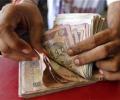
While some companies used that to become world leaders, others squandered it by over-borrowing.

Fresh guidelines were issued by the government on Wednesday for enforcing the second phase of the coronavirus lockdown, with the Union home ministry barring all kinds of public transport and prohibiting opening of public places during this period.

The 30-share Sensex ended down 30.30 points at 28,161.72 and the 50-share Nifty dipped 7.95 points at 8,543.

The study claims that from its peak of 18 per cent of gross domestic product in 2008, the crony capitalists' wealth is now down to three per cent

IT majors weakened ahead of the September US jobs data and telecom stocks ended lower

Lower IT exports will raise India's dependence on capital flows to fund imports.

Macro economic environment in India is expected to improve further and drive the BSE index, Sensex, to 33,500 by December-end.

Sensex, Nifty end the day in red on unfavourable cues from global markets.
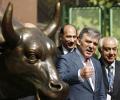
In 2008, the 13 companies on the list accounted for 34 per cent of the overall m-cap.

Sensex ended up 41 points at 29,136 and Nifty gained 4 pts to 8,809.
Dividend payouts seem recession-proof.

Brokerages expect Nifty50 firms to post 11.8% growth in net profit in Q1 but sales may decline
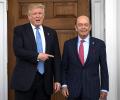
India Inc had cheered Donald Trump's decision to scrap TPP, but now there is a growing sense that it won't really lead to positive growth in trade with the US. Subhayan Chakraborty reports.
In the December quarter, Sensex earnings had contracted 5 per cent.

The top gainers on the Sensex are Gail(India), HDFC, Infosys.
Prime Minister Narendra Modi is not taking along an industry delegation to the US but top representatives of India Inc are likely to travel to New York and Washington to be part of the power-packed business meetings and receptions being hosted for him.
 © 2026 Rediff.com - Advertise with us - Disclaimer - Privacy Policy - Sitemap - Feedback - About us - Terms of use - Grievances